Showing posts with label professional development. Show all posts

Tuesday, January 10, 2012

Understanding Autism

I've been working with children who have Autism for about 2.5 years now. Through the process, I've interacted with various specialists, conducted my own research, and (of course) learned a lot from the children themselves. Mainly what I've learned is that Autism is incredibly complex, and there are a lot of variations within it. It means that working with any given child generally involves a lot of trial and error, and just because you have experience working with one child (or many) does not mean you will automatically know how to work with the next. Although I eventually gained something of an intuitive understanding of what Autism means after enough exposure to a number of very different Autistic children, I still struggled to lay it out in a way that could be explained to others.

Then, a couple of months ago, the school where I'm currently working sent me on a course about Autism. I learned about The Triad of Impairments (or, as some people prefer to call it, The Triad of Differences). Suddenly it was laid out in a way that made sense to me.
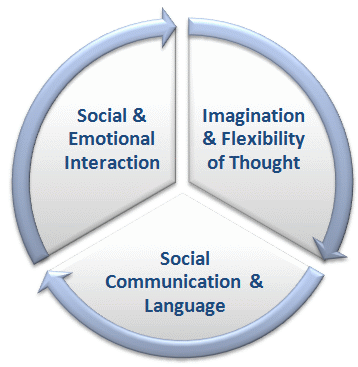

We talk a lot about the Autistic spectrum, but it's not (as I had imagined) a straightforward 2D spectrum. It's very much 3D.

Consider the graphic above.

Social & Emotional Understanding refers to the ability to understand social behaviour. Imagination & Flexibility of Thought refers to the ability to think and behave flexibly, and impacts on the development of restricted, obsessional, or repetitive activities or interests and difficulties in developing play skills. Social Communication & Language means the ability to understand and use non-verbal and verbal communication.

Each of these areas has its own spectrum, and any given individual can fall anywhere along each of them. Each of these areas also affects each of the other areas. Sensory sensitivities (again complex in their own right) overlap and affect them all. And underlying everything is a spectrum of cognitive ability. Some people imagine Autistics as Idiot Savants with one highly specialised skill. The truth is that this only occurs in about 10% of cases, and special skills can pop up anywhere along the cognitive spectrum. Some individuals may also have motor difficulties.

When we talk about "high functioning" Autism, what we actually mean is average to above average cognitive ability. A person with "high functioning" Autism may still find some or all of the other areas on the graph particularly difficult or distressing (note an interesting comment on Reddit by someone with Autism who calls high functioning Autism a misnomer). When we refer to someone with Aspergers, we are talking about someone with good verbal communication skills (though not necessarily good with non-verbal communication).

Having said all that, there's one more thing I think is important to mention. Why is there a movement toward calling this a Triad of Differences rather than Impairments? There's an argument that the Autistic brain is not impaired; it simply works differently. I'd love to do another blog post about that another day, but for now I'll leave you with this beautiful message from Jim Sinclair:

Being autistic does not mean being inhuman. But it does mean being alien. It means that what is normal for other people is not normal for me, and what is normal for me is not normal for other people. In some ways I am terribly ill-equipped to survive in this world, like an extraterrestrial stranded without an orientation manual.

But my personhood is intact. My selfhood is undamaged. I find great value and meaning in my life, and I have no wish to be cured of being myself. If you would help me, don't try to change me to fit your world. Don't try to confine me to some tiny part of the world that you can change to fit me. Grant me the dignity of meeting me on my own terms, recognise that we are equally alien to each other, that my ways of being are not merely damaged versions of yours. Question your assumptions. Define your terms. Work with me to build more bridges between us.

I hope that if you ever meet someone with Autism, you will use this information as a source of understanding and a guide for building bridges. Every child I've met has been a beautiful person, and every one of them has been my teacher as much as I've been theirs.

Saturday, October 16, 2010

Special Needs London

When I was little, I delighted in the gifts my parents brought home from their work conferences: pens, paperweights, bags, lanyards, stress balls, and sometimes even toys. I gleefully attended home shows where I scarfed down beer nuts while attempting to convince my parents they needed to buy me a trampoline. And I still have a framed computer-generated image of my aura that I got at a health and wellness show a few years ago. In short, I love conventions.

Today, I attended my very first career-specific exhibition. I was excited. But did Special Needs London live up to my expectations?

I'll be honest, I was looking forward to freebies of the ilk of those given to me as a child. Instead, I came home with an impressive collection of catalogues and brochures (my school will be happy), a demo CD of a literacy computer program, and a cute bookmark. I also wish there'd been more stalls offering information about SEN (special educational needs) rather than businesses trying to sell their wares.

But what about the workshops? I attended two seminars, and while they were certainly the best part of the event and succeeded in getting me thinking, I'm not sure I learned very much from them.

Narrowing the gap - practical ways to raise the achievement of vulnerable learners
There's a lot of talk in the UK about "narrowing the gap" between high and low achievers in schools, but Neil MacKay approached this topic from a different angle: narrowing the gap between a child's ability to think and their ability to present information/ideas or write them down.

Things I especially liked:
- He was clearly a skilled teacher and presenter
- He got us talking to each other, which originally I wasn't keen to do, but quite enjoyed in the end
- I learned that OFSTED considers gifted & talented students to be one of the two most vulnerable groups (yay, people are finally recognising this!)
- He talked about educating the parents about how their children learn and how they can support them, and said that by making the parents less vulnerable, their children become less vulnerable too
- He talked about how our teaching and assessment strategies can create (or eliminate) vulnerabilities in certain children

I didn't like so much that he referred to jargon and acronyms that I'm not familiar with yet and didn't spend much time talking about specific strategies. But I think most of the other attendees, who have more experience with the British education system than I do, understood what he was talking about and could see the applications. I guess I'll just have to do more research.

Not just talking: why children have behavioural, social, and emotional difficulties nowadays
This wasn't what I was expecting it to be, but was interesting in theory nonetheless. It was delivered by speech language therapist Sioban Boyce and was centred on the fact that many children growing up these days have limited exposure to normal human interaction, and therefore never develop important non-verbal communication skills. This lack of non-verbal communication ability leads to confusion and frustration that manifest themselves in behavioural, social, and emotional difficulties. Great stuff.

The trouble was that she was not a very good orator (and was visibly nervous) and she spent the entire hour basically bragging about how her work with these children has impressed people. She didn't really present us with any strategies we can use ourselves, short of sending them to do 1:1 intervention and speaking to them in ways that won't be overwhelming. I would have loved to know more about how she works with these children, not just that it works. She did happily point out, however, that she has books for sale and offers intervention courses. Based on her presentation today (essentially an infomercial that I paid £14.10 to see), I'm wary of giving her any more money for products that may not actually teach me anything.

----

In conclusion, I'm glad I went but I was a little disappointed with what I got out of the experience. I think I might possibly have been spoiled by TED talks.

I did pick up one very important bit of information, though: Angel is a really cool area for shopping. I want to go back there soon, preferably with money.

Saturday, September 18, 2010

Things you'll already know if you follow me on Facebook...

I finally have work! Well, sort of. I'm working half days in a Nursery (3 year olds) until next Friday (though I wound up staying a full day yesterday). It's a really lovely school and the staff have been extremely friendly to me (quite unusual!) and the kids are actually well-behaved (even more unusual!).

I remember last year when I was doing supply, I always felt as though I was fumbling through the day. Every school/teacher was different and I never knew exactly what was expected of me, much less where to find things or what the kids' individual needs were. But I guess a year of experience has done me some good, because I haven't felt that way at all this time. It was actually shocking to me, how confident I felt. And the other teachers seem to have noticed it too, because they made it abundantly clear they wanted me to apply for their permanent position. Of course, the application deadline was yesterday and I didn't find this out until after lunch, so I had to stay after school and write as quickly as I could in the half hour between the end of school and the deadline. (It meant missing capoeira too, grrr!)

There are a few cons to taking this job (the long, boring bus ride and the lack of challenge being two) and I don't even know whether I'll get it... but it feels really good to be appreciated and to have it confirmed that I can do this work. Sometimes I doubt myself. Being an agency employee in London can be pretty rough. Often the permanent staff will treat you like you're disposable and not a real human being.

It's also grad school application season. I'm applying for PGCE (Post Graduate Certificate in Education) programmes at both the Institute of Education and Roehampton University, but I also found a sweet MA in Special and Inclusive Education programme (about as ideal as it gets, seeing as I want to conduct my research on how children with Autism respond to creative education) at Roehampton that doesn't necessarily require me to get my PGCE first, so I'm applying for that too. The only way I'll be able to afford school is to go part-time, so heading straight into my MA would cut 2 years off my completion time. But it might also limit my career options when I'm finished. I'm not sure which option is better.

Other things:
- I'm continuing to stay busy and meet new people. I'm having a blast, but I'm also exhausted now that I'm back at work (I'd forgotten how tiring teaching can be).
- I'm in the process of becoming a Mentor for Kids Company. I can't even tell you how excited I am about that.
- I'm now in charge of planning workshops for Blues Revolution (which I have finally officially joined), and I have two coming up... a brand new one that I'll be teaching in October and our usual Beginner Intensive that my lovely friend Kavita will be teaching in November. Carter will of course be teaching both, because he's awesome like that.
- I have used parentheses excessively in this entry, and I will not apologise for it.

Sunday, November 8, 2009

Professional Development

Classroom Canada PD Week came at a good time for me: just as I'm transitioning into a new role with increased responsibility.

There were two workshop sessions, both offered by the massively entertaining and knowledgeable Sophie Walker. Sophie started off as an English and Drama teacher in Melbourne, and through various twists and turns, wound up as an Advisory Support Teacher in London (specializing in young children with Autism). For those of you following along at home, Sophie's job is pretty darned close to what I want to do. And they're paying for her to get her Masters degree, which is also in my plan. So it occurs to me that I must talk to her and figure out a path for getting there. Luckily, she works with some of the children at my school, including one I support. I'll be seeing her again in a couple of weeks.

The workshops themselves were pretty basic overviews. One was a survival guide to teaching in the UK and the other was on Special Educational Needs (SEN). We got some pretty good resources out of them, including a bunch of sites for downloading teaching materials. Seeing as I'm not actually a teacher, I didn't think I'd have much use for those, but then I had my first day at the new school...

I have very much been given ownership over this child's development. She does spend a good chunk of the day integrated in with the class, but I pull her out several times a day to work on phonics, numeracy, handwriting, and motor skills... and it's up to me to decide which activities we do. Enter handy resource websites. Thank you, Sophie.

I have a feeling I'm going to start using this blog more and more for talking about the various strategies I'm trying. One of the first things I want to do is convert her physical exercise routine (she has a series of exercises she does every day to build strength and balance) into something more interesting and fun (à la creative yoga). As it stands, her workout dissolves very quickly into silliness. I think she might get more out of it if the silliness were built right in.

In addition to my one-to-one student, I also work with a few other children in the class who have special needs that aren't severe enough to warrant being "statemented" (which means the government allocates extra funds for providing them with one-to-one support). One of them, a boy with autism, joins us for our afternoon tutoring sessions. A couple of others sit with us in class so I can help them all complete their work. And in my "downtime," I do whatever the teacher asks (distributing books, photocopying, etc.).

The teacher expects a lot, not just from me but from her class. The result seems to be quite positive. The students pupils are remarkably well-behaved and are learning things well beyond what you would normally expect from children their age in Canada. I'm hoping I'll pick up a lot of great strategies by working there.

The only part that is a little strange for me is that it's a faith school (Church of England). Prayer is built into their daily school life. I'm not religious so it's a bit awkward in that I'm not sure whether I should be praying with them. It takes me back to my days in Catholic school, when I used to refuse to sing in mass, and would throw bibles on the floor when I was feeling particularly rebellious. Thankfully, I'm a little more mature now and can probably handle it with more dignity this time around ;)

Anyway, I still have one more week before I start there full-time. This week, I'm booked for three days at the school where that boy tried to hook me up with his father, and where I witnessed the maths class that was completely out of control. I liked that school. Never boring, and lots of break time. But it's starting to look like I won't ever be going back to the hospital school, and that breaks my heart just a little.