Showing posts with label education. Show all posts

Thursday, June 7, 2012

Effective teaching and learning

I've started my pre-course reading. The first topic I'm tackling is "Effective teaching and learning," which apparently:
  • Equips learners for life in its broadest sense
  • Engages with valued forms of knowledge
  • Recognises the importance of prior experience and learning
  • Requires the teacher to scaffold learning
  • Needs assessment to be congruent with learning
  • Promotes the active engagement of the learner
  • Fosters both individual and social processes and outcomes
  • Depends on teacher learning
  • Recognises the significance of informal learning
  • Demands consistent policy frameworks with support for teaching and learning as their primary focus
The article then goes on to break all ten of those points down in wordy paragraphs. Good points, to be sure, but a little too analytical for me. Despite being a bit of a nerd about the topic, it was enough to make my head want to explode. Effective teaching and learning, for me, is relevant and engaging. That's it.

What knowledge/skills/attributes do I want my students to gain or develop? What relevant knowledge/skills/attributes do they already possess? What's the most effective way of bridging the gap between point B and point A?

Relevant: This word has a couple of meanings in this context. The material being learned should build on something they already know and it should be of some use or interest to them. Ideally, this use or interest should be made apparent.

Engaging: I don't necessarily mean this in the sense of "OMG every lesson must be FUN!" I do believe in having fun with learning whenever possible, but fun is a tool that can be misused and abused and sometimes misses the point. When I say engaging, I mean that students should engage with the material. They should use it, manipulate it, apply it, question it, and test it. This makes the learning stick, it makes it useful to them in a variety of contexts, and it also develops their ability to think and to learn. 

The rest of that stuff about valued forms of knowledge and congruent assessment et al. seems kind of implied, but perhaps I'm taking it for granted. What do you think? What does effective teaching and learning involve from your point of view?

Tuesday, January 10, 2012

Understanding Autism

I've been working with children who have Autism for about 2.5 years now. Through the process, I've interacted with various specialists, conducted my own research, and (of course) learned a lot from the children themselves. Mainly what I've learned is that Autism is incredibly complex, and there are a lot of variations within it. It means that working with any given child generally involves a lot of trial and error, and just because you have experience working with one child (or many) does not mean you will automatically know how to work with the next. Although I eventually gained something of an intuitive understanding of what Autism means after enough exposure to a number of very different Autistic children, I still struggled to lay it out in a way that could be explained to others.

Then, a couple of months ago, the school where I'm currently working sent me on a course about Autism. I learned about The Triad of Impairments (or, as some people prefer to call it, The Triad of Differences). Suddenly it was laid out in a way that made sense to me.


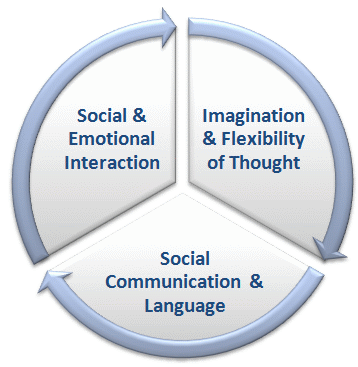
We talk a lot about the Autistic spectrum, but it's not (as I had imagined) a straightforward 2D spectrum. It's very much 3D.

Consider the graphic above.

Social & Emotional Understanding refers to the ability to understand social behaviour. Imagination & Flexibility of Thought refers to the ability to think and behave flexibly, and impacts on the development of restricted, obsessional, or repetitive activities or interests and difficulties in developing play skills. Social Communication & Language means the ability to understand and use non-verbal and verbal communication.

Each of these areas has its own spectrum, and any given individual can fall anywhere along each of them. Each of these areas also affects each of the other areas. Sensory sensitivities (again complex in their own right) overlap and affect them all. And underlying everything is a spectrum of cognitive ability. Some people imagine Autistics as Idiot Savants with one highly specialised skill. The truth is that this only occurs in about 10% of cases, and special skills can pop up anywhere along the cognitive spectrum. Some individuals may also have motor difficulties.

When we talk about "high functioning" Autism, what we actually mean is average to above average cognitive ability. A person with "high functioning" Autism may still find some or all of the other areas on the graph particularly difficult or distressing (note an interesting comment on Reddit by someone with Autism who calls high functioning Autism a misnomer). When we refer to someone with Aspergers, we are talking about someone with good verbal communication skills (though not necessarily good with non-verbal communication).

Having said all that, there's one more thing I think is important to mention. Why is there a movement toward calling this a Triad of Differences rather than Impairments? There's an argument that the Autistic brain is not impaired; it simply works differently. I'd love to do another blog post about that another day, but for now I'll leave you with this beautiful message from Jim Sinclair:

Being autistic does not mean being inhuman. But it does mean being alien. It means that what is normal for other people is not normal for me, and what is normal for me is not normal for other people. In some ways I am terribly ill-equipped to survive in this world, like an extraterrestrial stranded without an orientation manual.

But my personhood is intact. My selfhood is undamaged. I find great value and meaning in my life, and I have no wish to be cured of being myself. If you would help me, don't try to change me to fit your world. Don't try to confine me to some tiny part of the world that you can change to fit me. Grant me the dignity of meeting me on my own terms, recognise that we are equally alien to each other, that my ways of being are not merely damaged versions of yours. Question your assumptions. Define your terms. Work with me to build more bridges between us.

I hope that if you ever meet someone with Autism, you will use this information as a source of understanding and a guide for building bridges. Every child I've met has been a beautiful person, and every one of them has been my teacher as much as I've been theirs.

Saturday, October 16, 2010

Special Needs London

When I was little, I delighted in the gifts my parents brought home from their work conferences: pens, paperweights, bags, lanyards, stress balls, and sometimes even toys. I gleefully attended home shows where I scarfed down beer nuts while attempting to convince my parents they needed to buy me a trampoline. And I still have a framed computer-generated image of my aura that I got at a health and wellness show a few years ago. In short, I love conventions.

Today, I attended my very first career-specific exhibition. I was excited. But did Special Needs London live up to my expectations?

I'll be honest, I was looking forward to freebies of the ilk of those given to me as a child. Instead, I came home with an impressive collection of catalogues and brochures (my school will be happy), a demo CD of a literacy computer program, and a cute bookmark. I also wish there'd been more stalls offering information about SEN (special educational needs) rather than businesses trying to sell their wares.

But what about the workshops? I attended two seminars, and while they were certainly the best part of the event and succeeded in getting me thinking, I'm not sure I learned very much from them.

Narrowing the gap - practical ways to raise the achievement of vulnerable learners
There's a lot of talk in the UK about "narrowing the gap" between high and low achievers in schools, but Neil MacKay approached this topic from a different angle: narrowing the gap between a child's ability to think and their ability to present information/ideas or write them down.

Things I especially liked:
- He was clearly a skilled teacher and presenter
- He got us talking to each other, which originally I wasn't keen to do, but quite enjoyed in the end
- I learned that OFSTED considers gifted & talented students to be one of the two most vulnerable groups (yay, people are finally recognising this!)
- He talked about educating the parents about how their children learn and how they can support them, and said that by making the parents less vulnerable, their children become less vulnerable too
- He talked about how our teaching and assessment strategies can create (or eliminate) vulnerabilities in certain children

I didn't like so much that he referred to jargon and acronyms that I'm not familiar with yet and didn't spend much time talking about specific strategies. But I think most of the other attendees, who have more experience with the British education system than I do, understood what he was talking about and could see the applications. I guess I'll just have to do more research.

Not just talking: why children have behavioural, social, and emotional difficulties nowadays
This wasn't what I was expecting it to be, but was interesting in theory nonetheless. It was delivered by speech language therapist Sioban Boyce and was centred on the fact that many children growing up these days have limited exposure to normal human interaction, and therefore never develop important non-verbal communication skills. This lack of non-verbal communication ability leads to confusion and frustration that manifest themselves in behavioural, social, and emotional difficulties. Great stuff.

The trouble was that she was not a very good orator (and was visibly nervous) and she spent the entire hour basically bragging about how her work with these children has impressed people. She didn't really present us with any strategies we can use ourselves, short of sending them to do 1:1 intervention and speaking to them in ways that won't be overwhelming. I would have loved to know more about how she works with these children, not just that it works. She did happily point out, however, that she has books for sale and offers intervention courses. Based on her presentation today (essentially an infomercial that I paid £14.10 to see), I'm wary of giving her any more money for products that may not actually teach me anything.

----

In conclusion, I'm glad I went but I was a little disappointed with what I got out of the experience. I think I might possibly have been spoiled by TED talks.

I did pick up one very important bit of information, though: Angel is a really cool area for shopping. I want to go back there soon, preferably with money.

Saturday, July 3, 2010

Teaching children with exceptionalities

My apologies: this is going to be a long one.

A while back, I mentioned the school I want to create one day. Ever since I first came up with the idea, it's been running marathons in the back of my mind. I am constantly thinking about everything from building design and location, staff recruitment and development, funding and scholarships, daily schedule, how to incorporate a myriad of subjects/topics/methods/projects (and how to present them to a diverse group of "exceptional" kids), individual education plans, mentorship programs... everything. It literally never stops. What I should really do is acquire a notebook for recording all of my ideas, and actually I think I will do that at some point this weekend. But in the meantime, I'm going to do a bit of recording here.

This morning, I headed over to my local Eat. for coffee, breakfast, and some leisurely Saturday morning textbook reading. I have this wonderful book--Children with Exceptionalities--that I acquired for a distance ed course that I never finished (shame on me). I love that terminology because it's much more inclusive and positively spun than "special needs."

Quote:
We all have certain strengths, we all have limitations on our mental and physical ability, and we all have some disabilities, however minor, when it comes to learning. Most of these problems fall into common areas--a tendency to be easily bored, distractibility, poor study habits, poor memory, inadequate motor control, family interference, and so on. Some of us have problems learning a foreign language; others forget directions or people's names. For most of us, a perfect backhand is an unreachable goal. ... In some students, the learning difficulties are more serious, and the children deviate more significantly in one way or another. These are students who are exceptional. ... In an educational context, children are considered exceptional only when their educational program must be altered to meet their unique needs. ... Children who are gifted and talented are recognized as exceptional because they too need specialized help from professionals to fully develop their unique abilities. (4-5)

This is my target market. Children who are exceptional because they fall on either side of the normal range for mental, physical, or social ability, and therefore require an altered program to fully develop their skills. The range of skills and abilities therein is ridiculously broad and diverse. My challenge is to create a program that can be adapted to suit all of their needs. And not just to a regular mainstream standard, either. I want my students to possess a superior understanding of the world and develop the skills to successfully make positive changes within it. No small feat.

So how do I plan to achieve this? The answer to that is still a work-in-progress, as I still have many years of learning, research, brainstorming, and experimentation ahead of me. To be honest, I don't think I will ever perfect the system, but hopefully I will touch a few lives and get people thinking about how they can improve education (for all children, not just the exceptional ones).

So far, here's what I want for my school:
- Small classes with low staff to student ratios
- IEPs with regular reviews for every child (with which all staff will be familiar)
- Comprehensive staff development programs and a focus on teamwork and idea generation within the team
- Recruitment and selection processes for both staff and students that are designed to find people who are diverse but equally likely to thrive within the school's environment
- A "firm but fair" behavioural management policy that aims to work with individual children's needs and personalities and encourage child and familial input, but demands child effort and improvement to ensure that all children involved in the program can make most of it
- Child yoga and other similar activities every single morning (I've been doing yoga lately with my kids at school and not only do they love it, it's really having positive effects)
- Balance of structure and child-generated learning based on a Mantle of the Expert model
- Using the above mentioned Mantle of the Expert, learning through the arts, and other techniques to investigate a broad range of subjects and ensure holistic/cross-curricular learning and skill development
- Focus on real world applications
- Focus on school, community, and global involvement programs
- Lots of open, frank discussion and debate
- Peer tutoring and mentorship
- Employment of technology, social media, and old fashioned pen and paper to communicate and learn from people all around the world
- In the secondary program, allowing children to focus their studies on a particular area (if they so choose) while ensuring they also round out all other basic and related skills
- Co-op and entrepreneurship programs
- Creative problem-solving to implement high impact, low cost solutions
- A bunch of other stuff that I should have written down and will hopefully remember
- A bunch of stuff that isn't really relevant to this post
- A bunch of stuff I haven't thought of yet

Right now, I'm thinking a lot about how I can use this sort of approach to get kids to teach themselves more than just how to use a computer. I've also been thinking for a while about how my system applies to children with autism (mainly the primary module, as I already know the secondary format would be awesome for them). This blog post made me realize it might be a lot more relevant to them than I originally thought, but I plan to do a great deal more investigation on the subject (quite possibly through my Masters studies).

My current belief is that education that is relevant, hands on, and student-driven is adaptable enough to be useful and attractive to nearly all children. Every child will develop skills that will help them survive, flourish, and even make a difference in the real world. And every child will be able to pursue subjects that interest them to the fullest extent that they can. The idea is to encourage a love of learning, investigation, and creativity.

Just like the eventual program itself, I aim to make its development a collaborative effort. One of my challenges is making sure that everything I do transfers to a diverse range of children, not just what I think would have worked well for me. So my questions to you are: What made a real difference to you during your school years? What do you wish you'd had (more of) in school? What ideas for education have you come across that resonated with you? How would you expand on or modify any of the ideas I've mentioned? How could they have been adapted to best suit you or your siblings/children, particularly if you/they are considered exceptional?

I have piles of specific projects that I want to try, but I'll save those for another day.

Thursday, March 4, 2010

The school of my dreams...

... Will hopefully become a reality one day.

My life ambition has evolved quite a bit in the past few months. I've gone from wanting to consult on creative education for gifted kids and possibly starting a very small "home" school to... playing a bit role in the evolution of education by developing my own educational method and setting up my own small-but-much-bigger-than-before school for exceptional children of mixed abilities (gifted and special needs).

As though that weren't ambitious enough, I want this school to pull quintuple duty. In addition to a school, the building will also host a cafe/bar, a dance studio that is also a performance venue, and flats for hire upstairs (plus one for me). I'm going to try and get a rough plan laid out in the not-too-terribly-distant future so I can better illustrate how it'll work.

In terms of my educational method, I'm conscious of the fact that I should probably be careful to protect my "intellectual property." Part of me wants to just trust that if someone makes use of my ideas, they will properly credit me (and hopefully let me know about it as well). But just in case, I'm going to play it safe and be somewhat vague. I have a LOT of work to do before I have this all figured out, anyway, so I couldn't actually offer many details at this stage even if I wanted to.

Essentially, I want to combine what I think are the best ideas from every educational method/system out there: mainstream, special needs, Montessori/Waldorf, homeschooling, dramatic education, you name it. Ideas from different countries and cultures, too.

There will be both primary and secondary levels, most likely broken into what England terms "key stages" (but with slightly different age ranges).

e.g. Key Stage 1 = 5-7
Key Stage 2 = 8-10
Key Stage 3 = 11-13
Key Stage 4 = 14-17

Each key stage will be comprised of one class.

The whole way through the system, learning will be holistic and will focus on life skills, both vocational and domestic. There will be a big emphasis on creativity and critical thinking and just about everything will be hands-on. Every morning will begin with a bit of physical activity designed to help calm the body and focus the mind. Everything in mainstream curriculum (and more!) will be covered... in a much more fun, useful, and meaningful way.

In the secondary stage, the majority of the students' studies will be centred around "thesis" projects. The projects will follow different themes and have different requirements and, along the way, they will learn the skills needed to complete their projects. Some of these projects will be solo, some will be small group, and some will involve the whole class. Teachers in this area will act mainly as mentors and advisors, but teach some group lessons as well.

I'd also like for there to be a strong emphasis on diversity and community. The older and younger children will interact continually, both socially and through structured programs. We will eat and play together, and the older children will have a chance to mentor the younger children. Also, since this will be a school for both special needs and gifted students, children of mixed abilities and talents will be working together. I also plan to set up a scholarship fund so that the school can be accessible regardless of ability to pay.

So there you have it: my life ambition in a nutshell. I've been thinking about it obsessively all day, for some reason, so I just had to get it out there.

PS - I've already been approached by a few people looking for jobs. Yes, I am willing to consider possible future candidates now! Keeping in mind that I don't know when or where this plan will unfold. I'm also interested in hearing from people who wish to help me brainstorm or talk to me about what their ideal school would look like. I will eventually be looking for people to challenge and criticise my plan, but not yet. I want to have it more fully developed first.

Thursday, February 4, 2010

To Miss with Love and Disagreement

Thanks to Victoria's recommendation, I discovered To Miss with Love -- a compelling blog written by an anonymous inner-city school teacher in London. It is so fabulously well-written that I've found myself glued to it. So far, I've read over a year's worth of entries in a single evening. And yet... I can't help but disagree with a lot of what she has to say.

She goes through phases with the points she's trying to make. Just when I think I've established a trend, she'll switch to an entirely different one. First (in reverse chronological order), it was all about private schools. Private schools are automatically better than state schools. They breed children who take their studies seriously (which I know to be false because I attended private school--two of them--and they filled me with contempt) and who feel a sense of entitlement (which is apparently a good thing, because it gives them the confidence it takes to succeed). State schools inevitably fail to produce the same calibre of learners. Even the brightest students are doomed and will never live up to their potential. Most of the rest are on their way to the streets or prison or both.

Apparently this also has something to do with private schools not wasting time on frivolous subjects and creative education. Right. Well, I can sort of see where she's coming from. I'll admit I haven't been here long and my sample is small, especially in terms of mainstream education, but... for all the talk there is around here about creative education, I haven't actually seen it. My hunch is that it's a fad that most teachers don't actually understand and haven't properly implemented. In which case, yes, it probably is a giant waste of time.

Next, we take an interesting glimpse at the difference between students in Britain and India. We learn that "bad behaviour" in India involves wearing trousers with pockets on the outside, whereas Britain struggles with kids who constantly throw things and break into fights in class. Clearly, the fact that Indian children are grateful to go to school while British children feel entitled (wait, where did I see that word before?) to an education can be blamed for this discrepancy. Clearly, the solution is to eliminate state schooling. Nevermind that, say, Canada's education system is primarily public and doesn't see anywhere near the same level of chaos as what you'd find in a typical British school. Nor would you expect to find that same level of behaviour nearly anywhere else in the world, publicly-funded or not. I do think she has a point: We, in the Western world, do take a lot of things for granted. But I think it's far too simplistic to say that public education is at the root of all evil. And what was that again about a sense of entitlement being a good thing??

Finally, I'm on to the part about how children in the UK are not held accountable. Now here's some thinking I can get behind. She's right. You cannot hold a student back in the UK. I'm not even sure whether they get graded on their work (can someone clarify?). I think they just get tested on their abilities at the end of the year; the results of which are meant to reflect more on the school and the teachers than on the students. Why should they care about trying hard in school? It doesn't matter to them until it's too late... after they've already decided that they're not good enough and don't care about going to university, anyway.

Anyhow, for all the arguments I make, I still think To Miss with Love is an excellent blog that all educators should read. I submit that its author is obviously very experienced and a talented teacher, and I no doubt have a lot to learn from her. Debate on these topics is long overdue.

Wednesday, January 13, 2010

Behaviour Management

I was not an easy child. I was stubborn, underachieving, and prone to tantrums, and I feel deeply sorry for anyone who had to deal with me during those years. But I was also very self-aware and I remember trying, futilely, to explain that I would cooperate better if I were approached in a different way.

That memory forms the foundation of my theories about behaviour management. Figure out what makes a child tick and they will instantly respond to it. No tears, no stress. It usually works.

Children in London, however, are a different story. While all children need boundaries, British children need those boundaries to be tight and strictly enforced. This is the land of the stiff upper lip, where children are meant to be seen and not heard. They are accustomed to adults who are firm, distant, and regularly cross. Doomed is the teacher who tries to accommodate their pupils, for they will take that as a sign of weakness and promptly exploit it.

While I am not necessarily a fan of this approach, it is not without its merits. I've personally compromised on a balance that involves being kind, warm, fun, and encouraging most of the time, but quick to snap on my "don't mess with me" face the moment a child oversteps a boundary. I've noticed that many of the most successful teachers I've witnessed tend to do the same. I like this balance and I will probably stick with it no matter where I'm teaching.

The problem, though, is that a one-size-fits-all approach will never work for everybody. There are always going to be children who don't respond well to being scolded and punished for their misbehaviour. One of these children is in my class.

He's one of those kids who is always causing trouble of one sort or another; causing disruptions, bothering other children, refusing to listen. He winds up being told off over and over again throughout the day ("What's wrong with you?" "Why is it always you?") and spends at least a quarter of each day in time out. Clearly, something isn't working.

I tried talking to him about it today. I asked him what he liked about school (playing with others and maths) and what frustrated him (his teacher getting cross). I asked him if he knew why he did things to make her cross and he said that he didn't (and denied misbehaving to begin with). Then I said something that made his ears perk up: "I want to help you." I told him we could work toward him not getting in trouble all the time, but that he had to help me too. He agreed.

So that's my goal. So far, my hypothesis is that he simply isn't ready for the subdued, rigid structure of Year 2 in Britain (what 6 year old boy is, really?). He has excess energy that needs a better outlet, and would also benefit from some coaching on anger management. More positive attention probably wouldn't hurt, either. This site has some really good suggestions. I'm not sure yet how I'm going to go about this, though, given that I'm not his teacher (and his teacher has very different ideas on how to react to him). Your suggestions are welcome.

In other news, I am still frustrated to high heaven with this weather and London's inability to cope. I was stuck on my train for 2 hours this morning because the train in front of us broke down. I didn't get in to work until 10. Then my train on the way home was discontinued partway through due to chaos at Victoria station. It doesn't help the behaviour situation, either, when the kids aren't allowed to go play outside.

Ohhhhh when will it be spring?!

Wednesday, December 9, 2009

TA vs. LSA

In the short time I've been here, my job title has shifted from Teaching Assistant to Learning Support Assistant. These terms can sometimes be used more or less interchangeably, but at my school, it's an important distinction.

Every classroom has a TA. TAs assist in teaching and controlling the whole class. LSAs, on the other hand, are assigned to specific pupils who have been identified as requiring one-to-one support. There is some overlap, of course... I do help out with other things, but my assigned student is usually my first priority.

The required qualifications (having experience working with children) are technically the same for both roles, but I think most people are probably better suited to one or the other. I, for example, am definitely better off working as an LSA. I just like it better. But during my interview, the Head Teacher told me that there's no way she'd be able to stand working with the same pupil day in and day out. Different personality types, I guess.

So what does it take to be a great Learning Support Assistant?

Patience
When you're working with a child who has Special Educational Needs (SEN), learning and progress are bound to be part of a gradual process. Patience, understanding, and the love of a good challenge in this regard are absolutely vital.

Adaptability
Often, children with SEN require information to be presented to them in a variety of ways, and you may find yourself having to think up many new tricks on the fly. A solid understanding of pedagogy, as well as knowledge the child's individual needs, will help with this. Depending on what their needs are, their behaviour may also be unpredictable and you must be equipped to deal with that.

Ability to multitask
Your official role may revolve around one particular child, but that child does not exist in a vacuum. You will find yourself having to get involved in classroom management, administrative tasks, and teaching or assisting other pupils. You may also have to work in small groups with children who all have wildly different needs. Rarely will you find a moment when you don't have 5 or 6 children all trying to get your attention at the same time. You must be able to manage all of this at once, while still ensuring that your assigned pupil's needs are being met.

All of those qualities could be applied to being a TA, as well. But there's one more magical ingredient that's difficult to put into words.

What I love best about being an LSA is forming a bond with my student and watching her grow. It is a very personal experience and, for me, a very rewarding one. There have been days when I've gone home absolutely glowing, all because she successfully spelled a word, remembering to put the letters in the correct order. She and I celebrate many small victories together. She's rewarded with praise and stickers; I'm rewarded with big toothy grins.

To be a really great LSA, I think, you need to believe there's nothing better in the world than that.

Sunday, November 8, 2009

Professional Development

Classroom Canada PD Week came at a good time for me: just as I'm transitioning into a new role with increased responsibility.

There were two workshop sessions, both offered by the massively entertaining and knowledgeable Sophie Walker. Sophie started off as an English and Drama teacher in Melbourne, and through various twists and turns, wound up as an Advisory Support Teacher in London (specializing in young children with Autism). For those of you following along at home, Sophie's job is pretty darned close to what I want to do. And they're paying for her to get her Masters degree, which is also in my plan. So it occurs to me that I must talk to her and figure out a path for getting there. Luckily, she works with some of the children at my school, including one I support. I'll be seeing her again in a couple of weeks.

The workshops themselves were pretty basic overviews. One was a survival guide to teaching in the UK and the other was on Special Educational Needs (SEN). We got some pretty good resources out of them, including a bunch of sites for downloading teaching materials. Seeing as I'm not actually a teacher, I didn't think I'd have much use for those, but then I had my first day at the new school...

I have very much been given ownership over this child's development. She does spend a good chunk of the day integrated in with the class, but I pull her out several times a day to work on phonics, numeracy, handwriting, and motor skills... and it's up to me to decide which activities we do. Enter handy resource websites. Thank you, Sophie.

I have a feeling I'm going to start using this blog more and more for talking about the various strategies I'm trying. One of the first things I want to do is convert her physical exercise routine (she has a series of exercises she does every day to build strength and balance) into something more interesting and fun (à la creative yoga). As it stands, her workout dissolves very quickly into silliness. I think she might get more out of it if the silliness were built right in.

In addition to my one-to-one student, I also work with a few other children in the class who have special needs that aren't severe enough to warrant being "statemented" (which means the government allocates extra funds for providing them with one-to-one support). One of them, a boy with autism, joins us for our afternoon tutoring sessions. A couple of others sit with us in class so I can help them all complete their work. And in my "downtime," I do whatever the teacher asks (distributing books, photocopying, etc.).

The teacher expects a lot, not just from me but from her class. The result seems to be quite positive. The students pupils are remarkably well-behaved and are learning things well beyond what you would normally expect from children their age in Canada. I'm hoping I'll pick up a lot of great strategies by working there.

The only part that is a little strange for me is that it's a faith school (Church of England). Prayer is built into their daily school life. I'm not religious so it's a bit awkward in that I'm not sure whether I should be praying with them. It takes me back to my days in Catholic school, when I used to refuse to sing in mass, and would throw bibles on the floor when I was feeling particularly rebellious. Thankfully, I'm a little more mature now and can probably handle it with more dignity this time around ;)

Anyway, I still have one more week before I start there full-time. This week, I'm booked for three days at the school where that boy tried to hook me up with his father, and where I witnessed the maths class that was completely out of control. I liked that school. Never boring, and lots of break time. But it's starting to look like I won't ever be going back to the hospital school, and that breaks my heart just a little.

Wednesday, October 14, 2009

Namaste


My training with Rainbow Kids Yoga is paying off! I fired off an application today to be a freelance creative yoga instructor with Bigfoot Arts Education and, not a minute later, I received an invitation to their interview and selection day on November 6th. I'm not sure whether it was just glaringly obvious at a glance that I'm a perfect fit or whether they're inviting everyone who applies, but either way... woohoo!!!

I'm really excited about this opportunity, and about Bigfoot in general. The kind of stuff they do is right up my alley.

So now I have 3 weeks to come up some ideas for teaching each of their 6 sections:

- Arrive & centre
- Warm-up story
- Partner work
- Relaxation & reflection time
- Storytelling
- Group work

Shouldn't be too hard, but I'm glad I have a 420 page manual to help me.

Tuesday, September 29, 2009

So this is what they were talking about

Yesterday, I had my first experience in a mainstream school. I was working in the Speech & Language department, which is still special needs (learning support), but the kids seemed pretty normal to me. I guess everything is relative. After working with kids who can barely communicate, feed themselves, or go to the toilet on their own, kids who just have a bit of a harder time retaining information seem like downright geniuses to me.

The culture shock didn't end there, though. This school was enormous! Nearly 1500 students vs. maybe 50-100 at the others. It was completely chaotic.

First period, I helped out in a history lesson for students who had been pulled out of regular classes. They were talking about the slave trade, which was actually really interesting. I kept flashing back to The Book of Negroes (one of the best books ever - if you haven't read it, you should) while we went through the lesson, as pretty much everything we were talking about was chronicled in the book.

Second period, I was told I was supposed to be working with a couple of the boys from my first class, but they weren't in the room I was told they'd be in. They were, in fact, in French class. But they weren't supposed to be in French class, and when we finally found them, they came in with another teacher from Classroom who said he was meant to be working with them. So instead, I tutored two other boys... one of whom spent most of the time trying to set me up with his dad: "Miss, you are so beautiful. Have you got a boyfriend? Would you like me to find you one? My dad hasn't got a girlfriend. He was in a rock band. I'm going to tell my dad I found him a beautiful Canadian girl." Hilarious but a bit awkward.

Third (and last) period, I was in a regular Year 8 maths class as one on one support for one of the boys. I'm still not sure why I was there, since he didn't seem to need or want my help. I did my best to keep him on task and let him know I was there for him, but wound up spending most of my time helping out another boy who did genuinely want to learn. It was a bit of a challenge at first, since I barely remember how to do any math, but once the teacher explained it, I understood immediately. Which makes me wonder if maybe I should pick up some math workbooks and retrain myself. I may actually be decently good at it this time around.

Anyway, being in that class was certainly an enlightening experience. I've heard all this talk about how unruly classrooms in Britain are, but I hadn't experienced it yet for myself. I couldn't believe my eyes as I watched the class spent the entire period calling out, throwing paper balls, breaking and throwing pencil crayons, chatting, and fighting each other. The teacher had no control. I don't think he handled the situation very well, but then I imagine it must be really difficult to deal with that every day. How do you handle that? Not just in practical terms, but I mean, how do you handle the stress? How do you not let it wear you down, and have it turn you into a lesser teacher? I noticed that the teachers at my last school had become quite jaded, as well. How do you guard against that?

And how can I, as a temporary TA, help? I'm still learning how everything works over here, and of course it doesn't help that every school and every teacher has different rules and methods. I continually find myself in the awkward situation of trying to manage all the behavioural issues without actually knowing how they want them handled or what my boundaries and responsibilities are. I've kicked my observational skills into high gear and I'm learning a lot as I go along, but I long for a long-term placement where I can start to feel more in control.

Saturday, September 19, 2009

I've fallen in love

No, I haven't met any rich, handsome Englishmen yet. In fact, I've barely met any English people at all and need to do something to remedy that. But I have still managed to fall in love... with the students at the school where I worked yesterday.

Yes! I finally worked! And it was wonderful.

I received a call at 8:30 am asking if I'd be willing to help out in a Severe Learning Disabilities school. Yes! I had 10 minutes to get ready and figure out how to get there (Classroom helped with this, but I'm still in the habit of walking in the wrong direction absolutely every time I try to go anywhere). By the time I arrived, it was 10:10 am and I hadn't eaten breakfast aside from a juice box from the tube station. Oh well!

My class consisted mainly of 18/19 year olds, which I was shocked to learn because judging by their appearance, I would have guessed they were maybe 12. Tops. They all had profound and multiple disabilities (mental age of approximately 2.5 years old) and were among the lowest functioning students in the school. But holy cow were they ever happy and sweet. Same with the teachers. Everyone there was the embodiment of positivity.

Our day was a far cry from what you'd expect to see in a mainstream school. There weren't any lessons, per se. It was all sensory activity. Painting, massage, lots of time playing outside. They have one hour before or after lunch when they break off into various activity groups (visual art, sport, performing arts, and one more I didn't catch). These terms are used quite loosely. I spent time with the performing arts group, where they played Wii and with remote control cars and had a piano they could bang away at, and the sport group, where they did whatever they felt like outside. They had lots of props designed for stimulation. I wound up spending a good deal of my time jamming (singing and playing drums) with a musically talented Portuguese boy.

By the end of the day, I (and my new friend Lucy, the student with whom I spent most of my day) felt ready to pass out. Add in a very long walk to find the spot where I was to join my friends for supper (walked the right way, then doubted myself and walked the wrong way, then had to walk the right way again) and you get all the necessary ingredients for a very tired panda. But also a very happy one.

I am so impressed with the educational resources they have here. It makes Canada seem like a third world country in comparison.